Architecture
Open-source PIM vs cloud PXM, understanding the trade-off
Self-hosting Ergonode, Pimcore or Akeneo CE looks cheaper on paper. Year three, the spreadsheet tells a different story. The honest TCO breakdown, and when open-source is genuinely right.
May 9, 2026 · 4 min read · NEXERA team
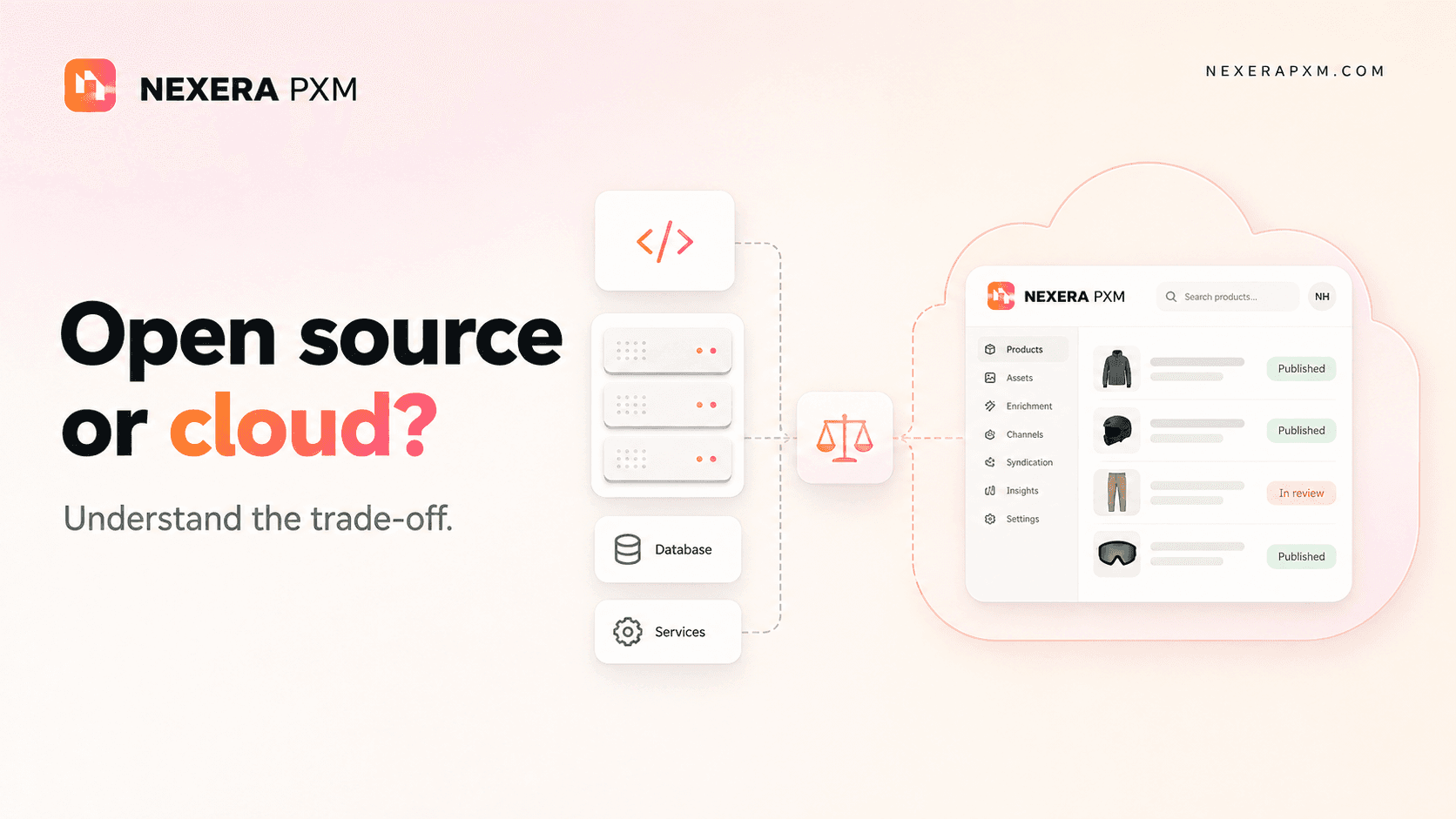
"We'll save money by self-hosting an open-source PIM." It's one of the most common decisions in mid-market commerce, and one of the most common regrets two years later. This is what the real trade-off looks like, the parts that don't make it into the vendor comparison spreadsheet.
On the open-source side: Ergonode, Pimcore, Akeneo Community Edition. On the cloud-SaaS side: hosted PXMs like NEXERA, Salsify, Plytix, Bluestone, and the commercial tiers of Akeneo. The same job, publishing products on channels, can come with wildly different cost structures.
The headline trap: "open-source is free"
It isn't. The licence is free. Everything else costs money.
What you actually pay for when you self-host:
Hosting infrastructure (compute, storage, CDN, backups, disaster recovery)
DevOps engineering time to deploy, monitor, patch, upgrade
Security: vulnerability scanning, dependency updates, penetration testing, SOC 2 if you need it
Database operations: tuning, replication, scaling, backups
Application engineering to extend, integrate, customise
Customer support, or the lack of it. You support yourselves.
For a real-world Ergonode or Pimcore deployment serving 10,000 SKUs with daily updates, you're looking at roughly:
€1.500–€4.000/month in cloud infrastructure costs
0.5–1.5 FTE of engineering time dedicated to running the PIM
€20.000–€60.000/year in plugin, theme and connector dependencies
That's €80k–€200k/year, conservatively. Before you ship a single feature.
The hidden costs nobody talks about
1. Upgrade purgatory
Pimcore 11 to Pimcore 12 was a real migration. Akeneo CE 6 to 7 was a real migration. Ergonode's API surface has shifted multiple times. Every major version is a project, typically 1–2 sprints for a well-managed deployment, much more if you've customised heavily.
Hosted SaaS doesn't have version upgrades. The platform you bought in 2024 is the platform you have in 2026, but better. No project, no migration window, no "we can't ship that feature until we upgrade first."
2. The integration tax
Open-source PIMs have plugin ecosystems. Hosted SaaS PXMs have native integrations. The distinction matters.
A plugin for Bol.com in Ergonode is a community-built module. It might work. It might be maintained. It might support the latest Bol API revision. If it breaks, you fix it. A native Bol.com integration in a hosted PXM is the vendor's responsibility; when Bol updates their API, the vendor updates the integration before you notice.
Multiply this by every channel you sell on. Shopify, Bol, Amazon SP-API, Google Shopping, retailer X, retailer Y. With open-source, every integration is your maintenance burden. With hosted, every integration is the vendor's.
3. The AI gap is widening
Open-source PIMs are slower to adopt AI deeply because adding AI to an open-source codebase is a community effort, not a product roadmap. Hosted PXMs have entire teams dedicated to building AI workflows.
In 2026, the gap is already visible. The AI features in a commercial PXM, workflow-embedded translation, brand-voice AI across tasks, attribute extraction from supplier docs, brand-voice copy generation, validation against channel-specific rules, are functionally a year ahead of what's available in the OSS ecosystem.
4. The security surface
Self-hosting a PIM means owning the security surface. Customer data, including product images, supplier data and sometimes pricing, sits on your infrastructure. If you don't have a security team, you don't actually know if you're compliant. SOC 2 is years of work and ongoing audit cost. GDPR is constant attention.
Hosted PXMs include this in the licence. The certification is the vendor's problem.
When open-source still makes sense
This is not "open-source is bad." Open-source PIMs are the right choice in three cases:
You're a development agency. You make money by customising and reselling. The platform is your billable surface, not your cost centre. Pimcore in particular is built for this model.
You have specific data sovereignty requirements that prevent SaaS. EU public sector, defence, some regulated industries.
You're at extreme scale where the per-SKU SaaS pricing becomes uneconomic and you have the engineering depth to operate at infrastructure-cost level. This is usually €500M+ in revenue.
For the brand or retailer with €5M–€100M in revenue, no in-house platform team, and a need to publish to 4+ channels in 2+ languages, self-hosting is rarely the cheaper option once you tally the full cost.
How to actually evaluate the trade-off
Build the honest spreadsheet. Three columns:
Open-source self-hosted: licence (€0) + hosting + engineering FTE + plugins + security + upgrades + support time
Hosted SaaS PXM: licence + onboarding + any extras
Akeneo Growth/Serenity (commercial open-core): licence + implementation partner + plugins
Three-year horizon. Honest assumptions. Run it.
The pattern we seeYear 1: open-source looks 30-40% cheaper. Year 2: open-source breaks even after factoring in real engineering hours. Year 3: open-source is more expensive than the equivalent SaaS, and the team is tired of running it.
The right question isn't "open-source or SaaS?" It's "do we want our engineers running infrastructure, or building features that move our revenue?" For most commerce teams, the honest answer is the second one. Open-source is for the teams whose product is the platform itself.